
The process of adapting to feminine hygiene: menstrual pads and liners
Striving for comfort and performance
At EDANA, we are convinced that menstrual pads represent one of the most enduring innovations in feminine hygiene. They have been continuously evolving to meet the diverse needs, comfort expectations, and lifestyles of women worldwide.
While they are often seen as simple absorbent products, they are more than that : today's menstrual pads are designed to manage menstrual fluid while supporting hygiene, comfort, and confidence throughout women’s daily life.
They sure have a functional role, but menstrual pads also serve a critical public health purpose : they enable full participation in daily life, whether at school, at work and during daily activities regardless of menstrual status.
They represent a frontline tool in addressing period poverty and advancing menstrual equity globally. All in all, one could say that they aren’t just consumer products, but essential components of women's health.
Understanding the multiple layers of comfort
Modern pad design combines several layers working in concert: first, a soft topsheet for skin comfort, then an acquisition and distribution layer for rapid fluid uptake, an absorbent core for fluid retention, a leak-proof backsheet for protection, and secure adhesives for reliable placement.
Each component undergoes individual safety assessment before integration into the final product. These products are subject to rigorous quality and safety evaluations that ensure consistent performance, as will be discussed later on.
The anatomy of menstrual pads
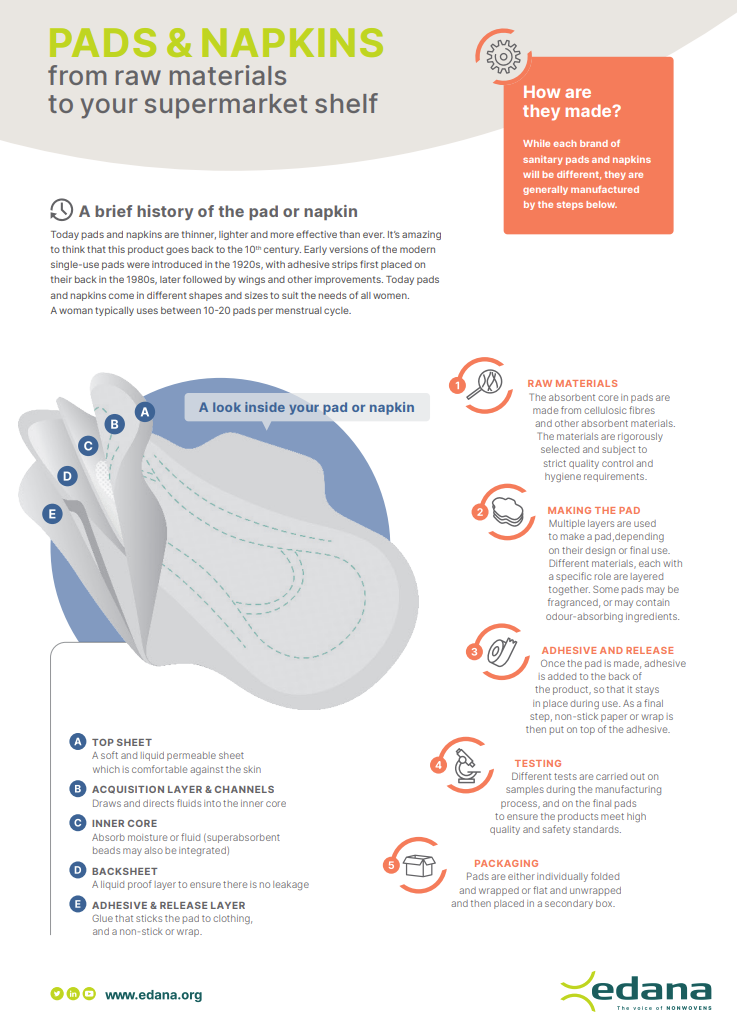
The menstrual pad infographic
Because an image is worth a thousand words, our comprehensive infographic provides a clear, step-by-step visualization of the manufacturing journey from raw materials to finished products on supermarket shelves.
This infographic can be seen as an educational tool. With it, we want to demystify the production process while demonstrating the sophistication in what might appear to be simple products.
The infographic illustrates each functional layer:
- The soft topsheet that contacts skin
- The acquisition layer engineered to guide fluid efficiently
- The absorbent inner core designed for maximum retention
- The leak-proof backsheet providing security
- The adhesive system with a release liner that ensures proper product placement during use
The manufacturing sequence is transparent, showing the careful selection of rigorously controlled raw materials, the precision assembly of multiple layers according to specific design requirements, the application of adhesives and protective release paper, comprehensive quality and safety testing protocols, and final packaging that maintains product integrity until consumer use.
The components breakdown table
Our detailed component table offers comprehensive information about every element comprising menstrual pads and liners.
For each layer, the table specifies:
Its functional purpose within the product
The material categories typically used
Examples of material types
Absorbent Hygiene Products components table
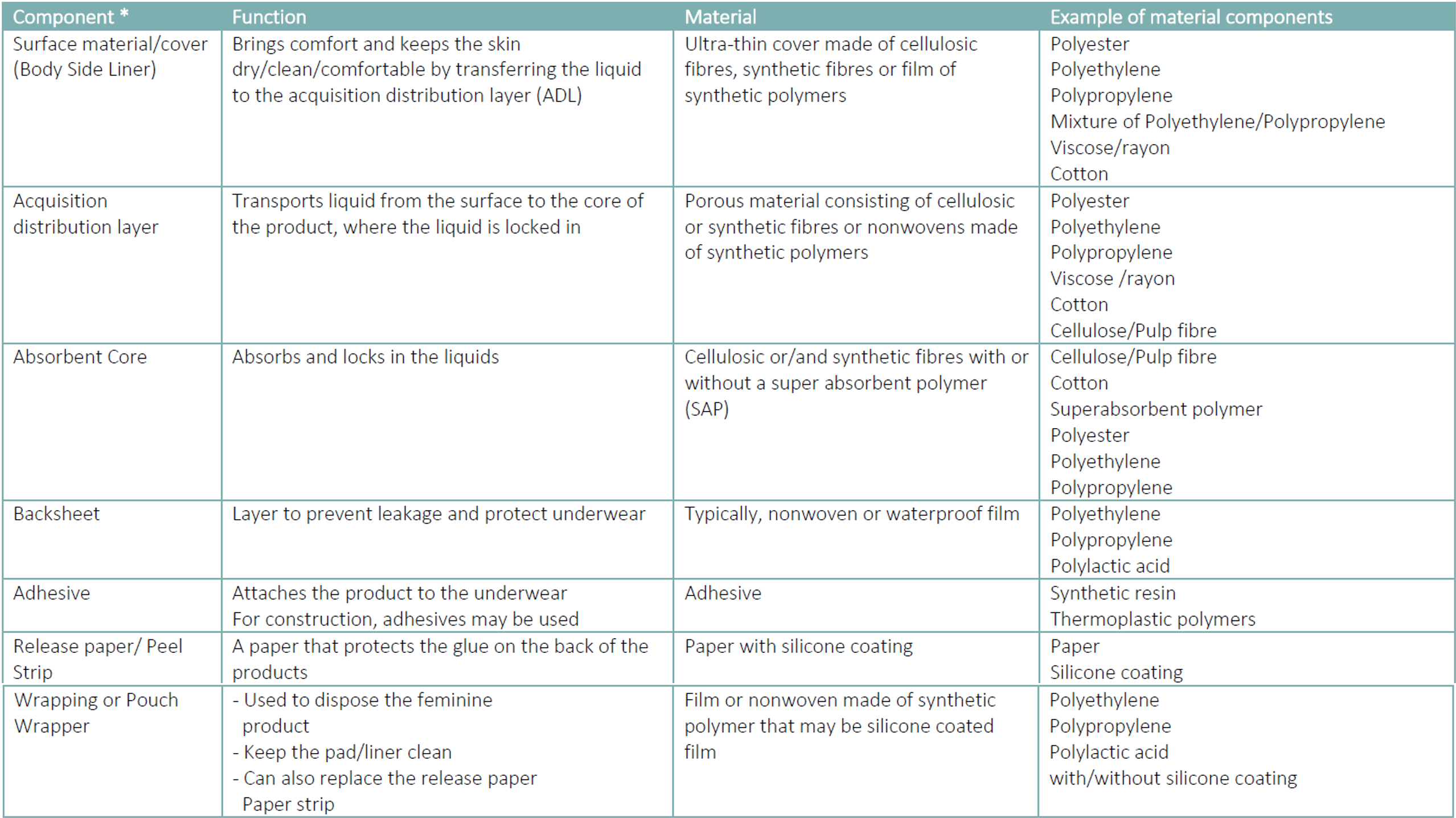
*Some of these components may not always be present in the final products
*Some layers may be colored bu inks,pigments and dyes used in small amounts to assist the indentification of components for ease of use and to make the products more appealing to use.
*Some pads are fraganced and if so, it is indicated on the pack
*Some pads/liners may contain some odor-absorbing ingredients.
With this document, we want to make clear how each element contributes to the menstrual pads’ performance: from the topsheet that touches the skin, through the absorbent core that provides capacity and retention, to the backsheet ensuring leak protection, adhesives maintaining product position, release paper protecting adhesive integrity, and the outer packaging preserving product cleanliness.
Product compositions vary according to design specifications and intended use profiles.
As for optional elements such as fragrances or odor-control technologies that may be added in the menstrual pads, their presence is indicated on the packaging, as it is required by regulatory and industry best practices.
What about testing standards?
At EDANA, we understand the growing demand for relevant, accurate, reliable, and comparable testing across the full spectrum of menstrual care products.
This is why we developed our “Menstrual testing guidelines”.
They are the definitive best practice tool for third-party organizations committed to scientifically sound product evaluation and meaningful result generation.
How were they developed ?
It’s through collaboration between experts from leading manufacturers, material suppliers, and specialized testing institutes with deep expertise in feminine care product evaluation that these guidelines were created.
They include all femcare product categories (panty liners, tampons, and sanitary pads). This means that they address every form of testing and each procedural step from initial design and methodology selection through result interpretation and stakeholder communication.
Statistical methodology and technical parameters were used and directly influenced test result accuracy and reliability.
Beyond technical and methodological guidance, the guidelines are also there to remind organizations conducting tests that there are fundamental principles that ensure testing integrity.
As a matter of fact, third-party tests designed to inform consumer decisions must incorporate user trials to validate real-world performance. To guarantee accurate testing that truly reflects consumer experience, organizations should engage directly with manufacturers and partner with laboratories that specialize in feminine care product evaluation.
Practical implementation support is embedded throughout the document, including contact information for EDANA member manufacturers, recommended testing laboratories with proven femcare expertise, standard method references for consistency, and validated user trial questionnaires.
For EDANA, the guidelines are a living document. We welcome feedback and input from the scientific and regulatory community.
AHP Labelling Guidance: Safety as a right for consumers
Transparency and clarity are key for the AHP (Absorbent Hygiene Products) industry. This is why in 2020, Edana launched its Stewardship program for Absorbent Hygiene Products along with a CODEX that features the list of trace chemicals, guidance values for each substance and a standardized consumer relevant test methods to evaluate products for possible traces of substances.
Currently, the EBRA method is the chosen method to evaluate consumer product safety.
The EBRA methodology is a well-known and widely used scientific approach based on key exposure parameters that can clearly indicate if a product has been contaminated and represents a risk for consumers.
Our comprehensive guidance document on AHP labelling is a framework for transparent and consistent communication about the product composition across all Absorbent Hygiene Products (including menstrual care items and baby diapers).
Developed by manufacturers committed to consumer transparency, this guidance serves as an educational resource that complements the legal obligations manufacturers must respect under existing product safety and labelling regulations. It doesn’t replace them.
The document contextualizes industry practice within the regulatory framework established by the EU's General Product Safety Regulation. The latter mandates that only safe products reach the market and that consumers should receive the appropriate information about any potential risks.
Within this compliance structure, the guidance explains how AHPs are designed and constructed, meaning : their sophisticated multilayer architecture and the diverse range of materials used, (including polyethylene, cotton, cellulose, and various synthetic or natural fibers selected for specific purposes).
We are aware that technical terminology can create barriers to clearly understanding the AHP labelling guidance. This is why this document suggests a consumer-friendly language for frequently used components, presented alongside standard industry technical terms.
This dual approach enables both technical accuracy AND consumer accessibility.
We think manufacturers should make composition information readily available through multiple channels, whether on product packaging for instance, or brand websites, or through digital tools such as QR codes. That would help make sure that consumers can easily know more about the products they use every day.
This commitment to accessible, comprehensive labelling reflects EDANA’s values in making sure that informed consumers are empowered consumers, and that transparency strengthens rather than undermines confidence in product safety.
More about menstrual pads
We can’t gather on a page all the content, technical information and expertise we hold on the topic. That’s why, for more technical resources, we invite you to consult the following documents:
