Re-Engineering Infrastructure

How Geosynthetics Are Revitalising Modern Construction

Over the past 40 years, geosynthetics and nonwoven geotextiles in particular have transformed infrastructure construction globally. In China, they have enabled the rapid and cost-effective expansion of roads, railways, airports, and harbours at a scale and pace previously unimaginable. In Europe and the United States, however, infrastructure construction still relies heavily on traditional mineral materials, representing both a missed opportunity and a growing competitive gap.

This session examined the current state of geosynthetics adoption in construction, the economic and environmental case for greater uptake, the barriers that continue to limit deployment in mature markets, and the innovative applications that are revitalising the sector. Moderated by EDANA’s Marines Lagemaat, the session featured experts from HUESKER Synthetic and TRI Environmental, Inc., alongside engagement with the International Geosynthetics Society.

INDEX Seminar Visuals

Want to watch the full seminar?

seminar_geosyn
1

CHAPTER 1

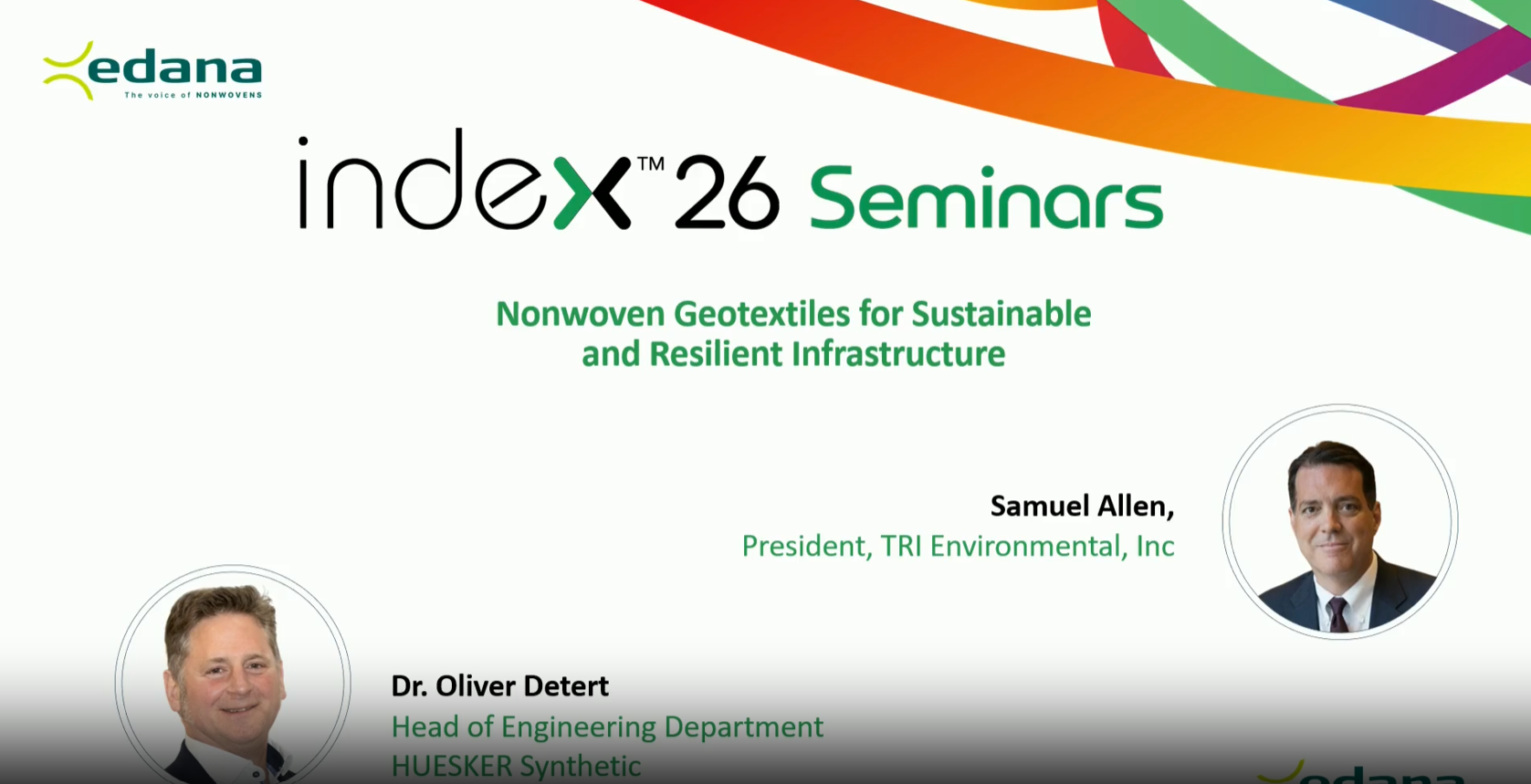
Nonwoven Geotextiles for Sustainable and Resilient Infrastructure

Presented by Dr Oliver Detert, Head of Engineering, HUESKER Synthetic, and Samuel Allen, President, TRI Environmental, Inc.

The central presentation explored the multifaceted value proposition of nonwoven geotextiles in infrastructure applications. Speakers addressed five interconnected questions that define the strategic case for geosynthetics in modern construction:

  • How can nonwoven geotextiles improve the durability and performance of modern infrastructure projects, and what economic and environmental benefits do they offer compared to traditional construction materials?
  • What are the economic implications and carbon footprint impacts of using nonwoven geotextiles across civil and geoenvironmental applications — and how can these benefits be effectively quantified and communicated?
  • What are the main barriers to broader adoption of nonwoven geotextiles, and what opportunities exist to accelerate their uptake in infrastructure development globally?
  • What actions are needed to increase awareness, confidence, and widespread use of nonwoven geotextiles within the construction and engineering community?
  • What role does the International Geosynthetics Society play in promoting sustainable and resilient infrastructure in response to growing global demand?

The presentation drew on real-world project case studies demonstrating how nonwoven geotextiles deliver superior performance outcomes — in terms of load distribution, drainage, filtration, and separation functions — while offering meaningful advantages in carbon footprint and whole-life cost compared with the mineral material alternatives they replace.

2

CHAPTER 2

Innovation Applications and Market Opportunities

Building on the performance case, this segment explored specific innovative applications of geosynthetics that are creating new market opportunities: from coastal protection and erosion control to landfill engineering, railway trackbed stabilisation, and the role of geosynthetics in making infrastructure more resilient to the effects of climate change. The discussion highlighted how innovation in geosynthetic design (including multi-functional composite structures incorporating nonwoven layers) is expanding the range of applications and performance characteristics available to infrastructure engineers.

Key Takeaways

  • Nonwoven geotextiles offer proven, measurable performance benefits in infrastructure applications including improved durability, reduced carbon footprint, and lower whole-life costs.
  • The primary barrier to adoption in mature markets such as Europe and the US is awareness and familiarity within the engineering and construction community, not technical performance.
  • Overcoming this awareness gap requires coordinated effort from industry associations, academic institutions, and leading practitioners to build a robust evidence base and disseminate it effectively.
  • Climate change is creating new demand for geosynthetics in resilient infrastructure applications, opening significant growth opportunities for the nonwovens industry.

Speakers

Dr. Oliver Detert

Dr Oliver Detert

Head of Engineering

HUESKER Synthetic 

Samuel Allen

Samuel Allen

President

TRI Environmental, Inc 

Marines (1)

Marines Lagemaat

Scientific & Technical Affairs Director

EDANA 

Want to know more about it?

Learn more about how EDANA can help you and your company.