Lightweight, Quiet, Sustainable

Nonwovens at the Heart of Next-Generation Mobility

The global mobility sector is undergoing one of the most profound transformations in its history. The simultaneous shift towards electrification, autonomous driving, and sustainability is fundamentally reshaping vehicle design requirements — and nonwovens are at the centre of this transformation. Their unique combination of lightweighting potential, acoustic performance, thermal management capability, and formability make them indispensable materials for the next generation of vehicles.

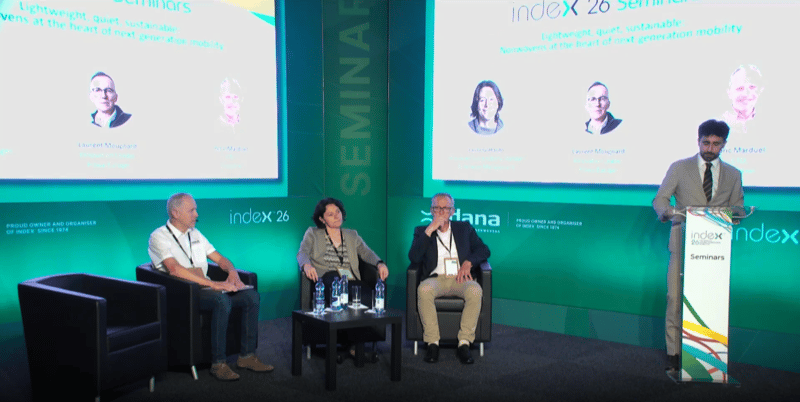
This session examined how nonwoven materials are enabling automotive manufacturers and Tier 1 suppliers to meet the complex, often competing demands of next-generation vehicle design. Moderated by EDANA’s Communication Expert, the session featured two highly complementary presentations, one focused on material substitution and circular design, the other on process innovation for sustainable composite manufacturing.
INDEX26 Seminar Slides

Want to watch the full seminar?

index26_seminar_automotive
1

CHAPTER 1

From PU to Polyester: Enabling Circular Automotive Solutions Through Advanced Nonwovens

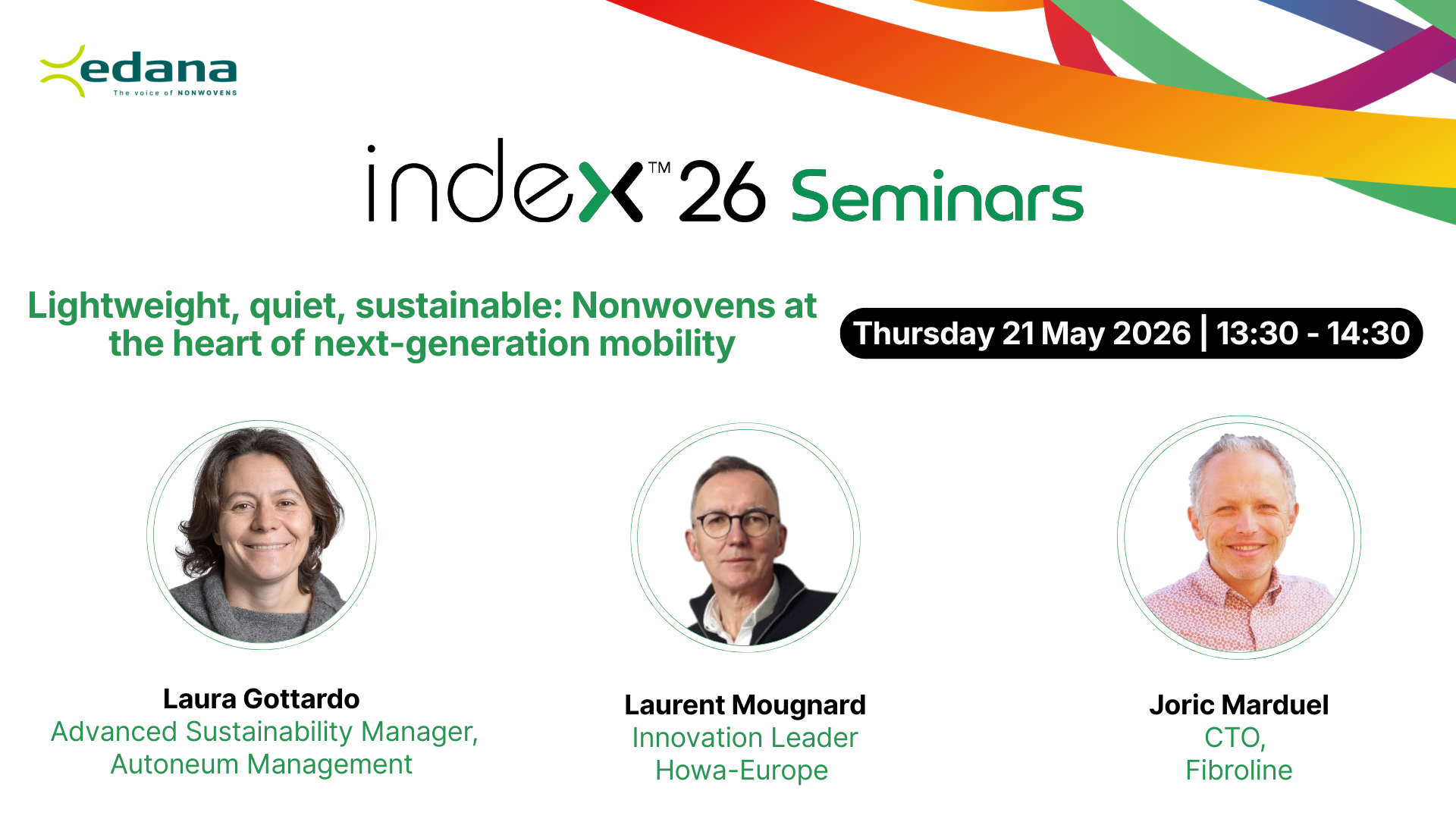
Presented by Laura Gottardo, Advanced Sustainability Manager, Autoneum Management

Laura Gottardo presented Autoneum’s pioneering work in substituting polyurethane (PU) foam with advanced polyester nonwovens in automotive interior applications. The substitution addresses one of the most significant sustainability challenges in automotive manufacturing: PU foam is widely used for acoustic and thermal performance but is extremely difficult to recycle, presenting a major obstacle to achieving circular economy objectives for end-of-life vehicles.

The presentation addressed three critical questions for automotive OEMs and material suppliers:

  • How can polyester nonwovens replace polyurethane in automotive applications whilst maintaining acoustic attenuation, lightweighting, and formability performance — the three properties for which PU has historically been specified?
  • What technological advances now enable the full recyclability and circularity of polyester-based automotive components, and how does this align with upcoming end-of-life vehicle regulations?
  • How can OEMs and Tier 1 suppliers scale polyester innovations to meet the dual pressures of regulatory compliance and rising market demand for sustainable mobility materials?

Autoneum’s research demonstrates that polyester nonwovens can meet or exceed the acoustic and performance specifications required for key vehicle components, whilst offering a clear end-of-life recyclability pathway that PU foam cannot match. The presentation outlined the remaining technical and commercial challenges and the pathway to scaling these solutions across the global automotive supply chain.

2

CHAPTER 2

Dry Powder Impregnation for Next-Generation Mobility: High-Performance, Sustainable Automotive Headliners

Presented by Laurent Mougnard, Innovation Leader, Howa-Europe, and Joric Marduel, CTO, Fibroline

The second presentation introduced Fibroline’s dry powder impregnation technology and its application in the development of high-performance, sustainable automotive headliners in collaboration with Howa-Europe. Dry powder impregnation represents a fundamentally different approach to composite manufacturing: by electrstatically applying dry powder binders directly into nonwoven or fibre substrates rather than using wet resin systems the process eliminates solvents, reduces energy consumption, and enables the use of bio-based and fully recyclable binding materials.

The presentation addressed the key questions that this technology raises for the wider mobility and manufacturing community:

  • Can electrostatic technologies be applied to other products in the mobility sector beyond headliners, and what is the potential market scope?
  • Are there viable solutions using bio-based or 100% recyclable materials that can be integrated into the dry powder impregnation process?
  • Will dry-process technology enable the development of entirely new product categories for sectors beyond automotive?
  • Is dry-process technology suitable for developing innovative, environmentally friendly composites across a wider range of industrial applications?

The presentation demonstrated that dry powder impregnation produces headliners with competitive acoustic and structural performance, whilst offering a meaningfully reduced environmental footprint compared with conventional resin-impregnated composites. The technology is positioned as a platform for broader innovation across mobility applications and beyond.

Key Takeaways

  • Nonwovens are indispensable to next-generation vehicle design, enabling lightweighting, acoustic performance, air filtration, and thermal management in a single, versatile material platform.
  • The shift from polyurethane to polyester nonwovens represents a significant sustainability advance for automotive interiors, providing a viable circularity pathway that PU foam cannot offer.
  • Dry powder impregnation technology is opening new possibilities for sustainable composite manufacturing in automotive and other mobility applications, eliminating solvents and enabling fully recyclable solutions.
  • The convergence of electrification, autonomous driving, and sustainability regulation is creating significant structural demand growth for advanced nonwovens in mobility applications globally.

Speakers

laura

Laura Gottardo

Advanced Sustainability Manager

Autoneum Management 

laurent

Laurent Mougnard

Innovation Leader

Howa-Europe 

joric

Joric Marduel

CTO

Fibroline 

felipe

Felipe Cossio Cuartero

Communication Expert

EDANA 

Want to know more about it?

Learn more about how EDANA can help you and your company.